Odradek's Drift Reflections
I wrapped up my first brief Classic Traveller campaign this week. I had a huge amount of fun running it and am extremely grateful to everyone who showed up to play.
Though short, playing Traveller really captured my imagination and left me with lots of thoughts -- just keep in mind that all this is coming off of 7 sessions (albeit several more in various campaigns as a player), so I cannot claim to speak with authority -- just processing my experience.1
Here are all the reports from individual sessions:
Making CT Work for Me
Pre-campaign
I stuck to the '77 booklets, with minimal use of supplements. Like with 3LBB OD&D, 3LBB Traveller allows for open-ended interpretation with functional constraints. I like that there are well-defined starship rules but no starship illustrations, because I wanted to draw my own. I like that it provides specific backgrounds but lacks an explanation of what (e.g.) the "Other" service actually is, because it's fun to make deductions from the skills and mustering out benefits.
I found it helpful to consciously treat Traveller as a fantasy game. This has been discussed before. In my case, I had fun mashing together a crazy pastiche of stuff I happen to like (even if it's recycled from other games/projects) -- thus, I tossed in Castalians from The Glass Bead Game, the proboscideans from Castle Mordengard, the Coca Cola corporation, and other bullshit that I find amusing, appealing, or compelling.
I chose to do most of my prep in a beautiful old engineering notebook I had inherited from my grandfather. Although the exigencies of running a campaign online did shunt some of my efforts toward digital, I did all the planet writeups, the sector map, illustrations, and lists by hand. Doing this helped me recover from a bit of post-AAJ burnout by distancing CT prep from any kind of potential publication.
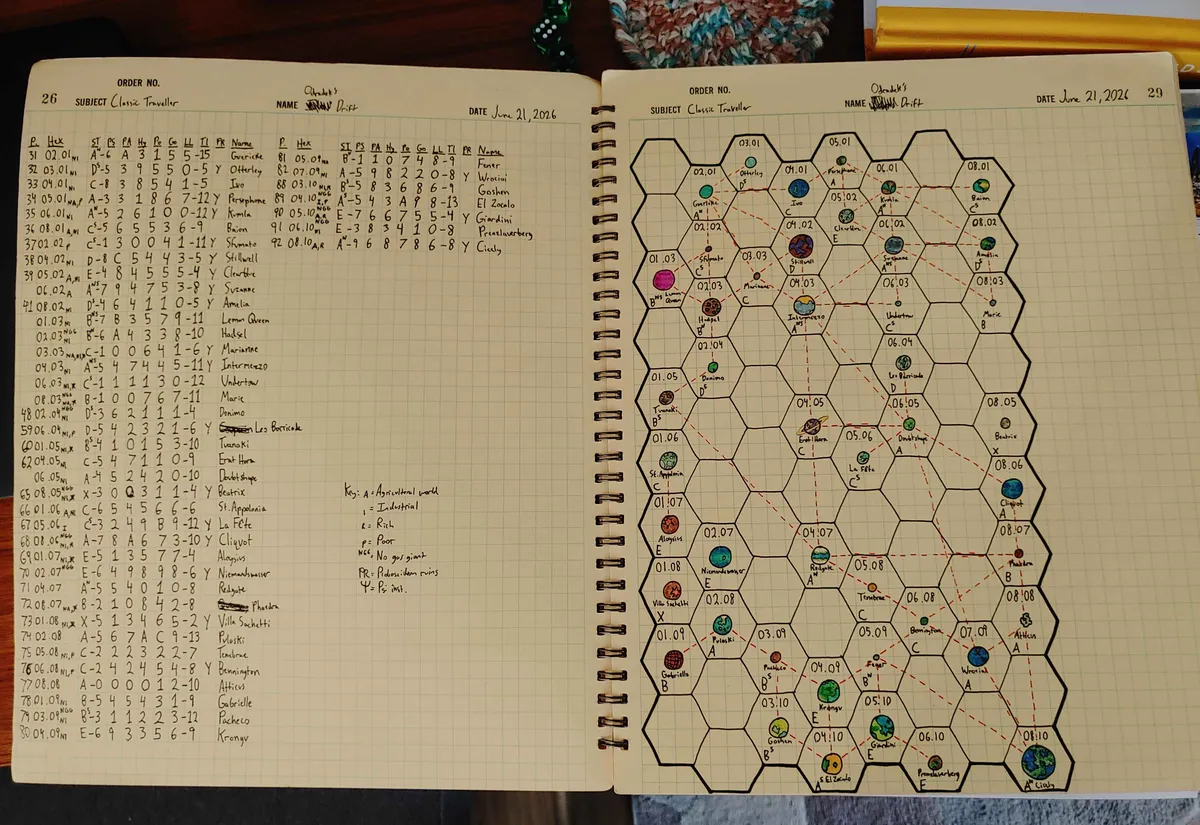
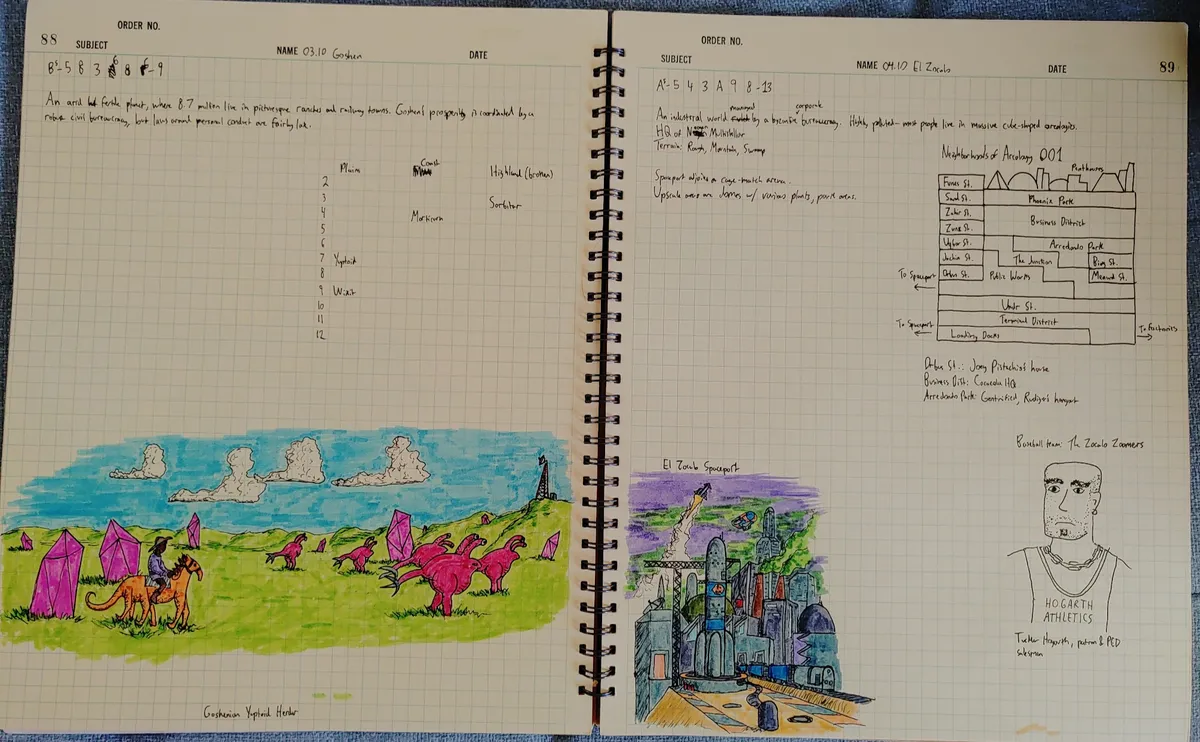
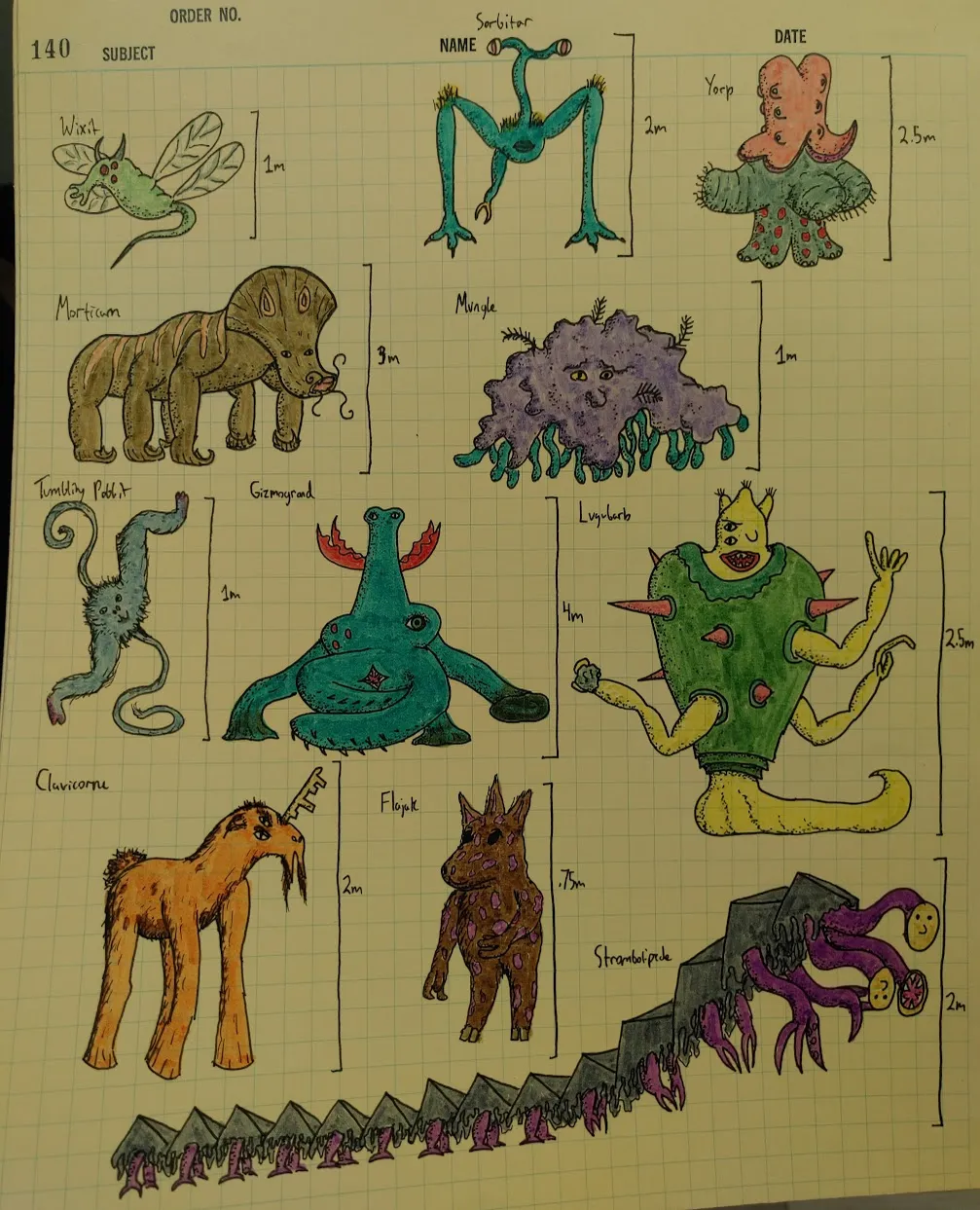
In that vein (and as noted below), I avoided "formulaic game writing" as much as possible. Odradek sector exists as scribbled notes, doodles, diegetic quotations, and poorly-organized lists (of names, book titles, corporations, alien monsters, etc.). There are also notes from past campaigns and settings. I consciously framed it as a solo journaling game where the process of rolling and interpreting worlds was an end in itself that did not need to be validated through play.
Running the campaign
Open-table CT
I ran Odradek's Drift as an open-table pickup game. I enjoyed getting to run for a variety of players old and new, and am extremely grateful that every session had at least 3 players show up. With that said, I think Traveller is tougher to run this way than a dungeon-crawl. Whereas for D&D you can say, "here's the map so far, go find some treasure", Traveller patron missions tend to produce convoluted plot threads that are harder to loop new players in on. Thankfully, by session 4 or 5 there were enough consistent players to keep some continuity.
I ended up imposing a 5-player cap after the second session, as I find managing a large table to be harder than in D&D. Even though the CT crew was consistently working toward shared goals, it felt like there was a stronger tendency to split up and pursue different tasks. As ref, I had to consciously make sure I was checking in with quiet players and being fair about how I allocated time and energy to resolving character actions.
Patron missions
The component I was most apprehensive about was the table of patron encounters on p. 22 of Worlds and Adventures. I won't rehash Traveller: Out of The Box, but in short it's pretty clear from the text that referees are expected to improvise jobs during a session based on a randomly generated patron.
This turned out to easier than I expected. For one thing, there was often a merciful gap between meeting a patron and actually pursuing a lead. Tucker Hogarth the steroid-seller (a "Shopkeeper" patron I rolled during session 2) felt really flimsy at first, but in the week between sessions 2 and 3 I had time to mull over the situation and flesh it out into a reasonably fun scenario.
Moreover, a mission only needs one or two "hype moments" to feel worth it, and these can often be fulfilled with a random encounter roll. "Lead-up" activities like investigation, surveillance, and research often feel fuzzy and not very compelling, but I think the key to making a patron mission work is knowing when to seize upon the ingredients in play to create a tense shootout, funny/memorable conversation, unexpected twist, or similar.
I adopted a few house-ruled additions:
- I used Chao's mission distance table to determine if a mission's target was nearby or another planet.
- I followed the common advice of rolling a second time on the table to determine the "target" of a mission, and likewise used a reaction roll to determine the "vibe" (on a low roll: violent or hostile, on a high roll: peaceful investigation/negotiation/transportation)
- I didn't adopt a random die roll for mission payout, but I did need spend time familiarizing myself with the equipment and ship prices to get a feel for a "reasonable" payout range.
I eschewed Supplement 6: 76 Patrons, though I would definitely use it for future games.
Prep & improvsiation
The standard advice to "prep one session ahead" rarely works for me; I need a certain amount of distance between preparing a scenario and running it, otherwise the prep starts to feel like homework and the play starts to feel contrived.
Instead, I wrote detailed session reports to consolidate and memorize the increasingly-convoluted game state. I took these as opportunities to further develop the game world by incorporating doodles, direct quotations, and short stories. And in the background, I freely added planet writeups and doodles to my notebook. I would also run through leads in my head while falling asleep at night, trying to visualize the people and locations involved.
Traveller is interesting because its intended scope forces certain issues. Running D&D offers the tantalizing possibility of pushing ever-closer to a 1:1 map -- you can detail every NPC in the town like City State of the Invincible Overlord or catalog every dungeon feature like Arden Vul. I'm too lazy to ever truly succumb to the neuroticism of perfect prep, but I have been tempted before.
But in CT, you roll up a planet with 10 billion people and "blorb principles" fly right out the window. So you can either do the "trad" thing and build a few miles of railroad tracks out ahead of your players, or you can take the leap of faith accept that the fine-grained details of the world have to be brought forth during play.2
Improvisation and prep aren't antitheses; to improvise well, you need to prepare. But that prep has more to do with curating a mental repertoire of compelling images, characters, & places (by generally trying to be curious and observant about whatever parts of the world interest you). The ingredients of Odradek's drift aren't very brilliant or original, but they are a pastiche of things I love & which provide an organic buoyancy that made it possible to improvise effectively. Likewise, a lot of my prep consisted of stupid little doodles because stupid little doodles amplify that feeling whereas formulaic writing tends to exhaust it.
Krongu Green Slime
I came up with the campaign premise on a whim -- ripping off riffing on my favorite Jeffrey Lewis song. I'm very grateful to the players for committing to the bit. Technically, nothing prevented them from jettisoning all 66 metric tons into deep space and then filling the cargo hold with something that actually had value, but the efforts to market and sell the goo made for some splendid outlandish schemes.
El Zocalo
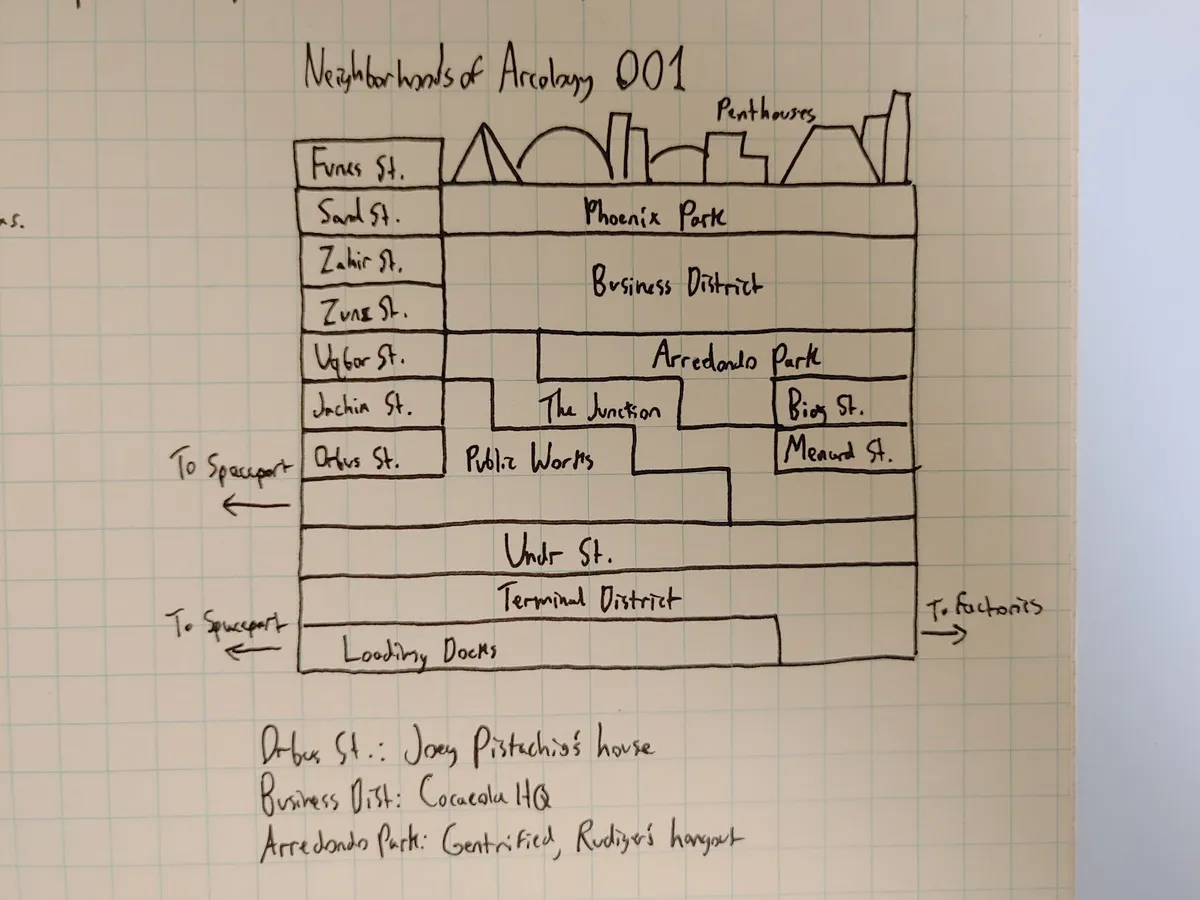
Most of the campaign took place on a single planet, and it happened to be the type of single planet I was most apprehensive about running (population in the 10s of billions!). Ultimately, it was a non-issue, you just handle it like anything else (see above). When prepping the planet, I had written that most people live in large Blade Runner-esque arcologies (due to the tainted atmosphere), so I had most of the action take place in Arcology 001, next to the spaceport.
I did wait a bit too long to draw a map of the arcology -- this wasn't a huge deal, as I had a general mental image of the layout and types of places that were available, but sitting down and actually drawing out the different districts and floors helped me make it more concrete. Likewise, naming each district made the improvisation feel more concrete. (Instead of, "oh, his apartment is in a shitty run-down street on the lower levels", it becomes "oh, his apartment is on Jachin St., a shitty run-down street on the lower levels" -- which sounds slightly less like I just invented it on the spot).
Anyways, the main takeaway is that although I was hoping for more spacefaring, Traveller indeed works just fine on a single planet because the real meat of the game (patrons and random encounters) works anywhere.
Traveller combat
It's good. I like that it uses simultaneous initiative, that it has a weapons vs. armor matrix, and that it's quite lethal.
I tended to treat it as a Boot Hill And The Fear of Dice kind of thing, where fights were either trivially easy if you have the element of surprise and a good plan, or near-fully random in cases where a negotiation devolved into a shootout. I don't think this is the only way to run it -- you could also run crunchy tactical grid-square fights, especially if players are well-armored -- but it's what made sense for the kind of game I wanted.
One small issue I ran into: Traveller implies that melee weapons are commonplace, and it seems like the planetary law levels are intended to steer players away from solving every problem with overwhelming firepower. But even though El Zocalo was a law level 8 world (out of 9), my players were pretty cavalier about taking guns along. The '77 booklets allude to using die rolls to evade legal trouble, but I had a tough time knowing when and how to implement them, and it was a bit tough to know what to do if players actually got arrested. Thus, I wrote my own rules -- these came to late to really see much use but I was glad to have them.
Skills
The first OSR games I tried, Stars Without Number and Worlds Without Number, both used Traveller-inspired 2d6 skills, but the way CT implements skills is subtly superior.3
CT's skill list is judicious about how skills elide play. Whereas S/WWN have a Talk skill that can be used for anything related to talking (at the ref's discretion), CT has Bribery, Gambling, Streetwise, and Admin -- specific types of verbal and mental activity that are tedious and repetitive, and thus worth eliding. Likewise, most of the other skills pertain to technical tasks that are relevant to the sci-fi backdrop but not the the actual gameplay "meat" of negotiation and ad-hoc problem solving.
Also, the fact that CT skills don't advance over the normal course of play is important. In S/WWN (but also 3e, 5e, Pathfinder, etc.), characters are expected to increase the numerical value of their skills, and there's a sense that if you aren't using those skills, you're not benefitting fully from the advancement you earned. Thus, the referee is under pressure to let players elide gameplay by rolling skill checks. Traveller skills, being static, are easier to frame as being more like saves -- relevant only in dicey situations that are best avoided, or otherwise part of the game's procedural background simulation.
Finally, CT skills are (often) attached to individual subsystems; there isn't a unified mechanic or sense that disparate skill types are somehow meaningfully commensurate on an absolute scale of "proficiency".
Ending the Campaign
I chose to end Odradek's Drift a bit abruptly, though I had always planned for it to be a limited run. The conclusion of Session 7 was both a fulfillment of the original campaign objective and a dramatic shift in scope and player resources.
It seems like it's more common for campaigns to fizzle out than to consciously end (which is fine and natural, not at all something to lament), but when handed the opportunity to wrap up the campaign with an exciting and reasonably satisfying conclusion, I decided to take it.
I'm excited to use the same sector in future games -- I've already edited the Krongu UPP and description to account for the Bluxist revolution. I think having a straightforward goal and a short scope was really nice, and I will probably do a similar goal-oriented setup in the future (c.f. Unturned Hovel reflecting on lessons learned from his excellent Frydheld sector game).
I also have a very silly top-secret project set in the sector that I hope to announce soon.
Anyways, all this rambling is a bit self-indulgent for a seven-session campaign, but Classic Traveller really got all three of my neurons firing. If you're curious about it, I highly recommend grabbing a copy of Traveller: Facsimile Edition and taking it for a spin! It certainly made me feel much more comfortable with an open-ended, improvisatory style of play, and it may even fix your soul.
Though, as I discuss in the post, you could also say that it's based on several months of avidly playing Traveller as a solo journaling game.↩
At the risk of being an RPG taxonomy dork, Traveller occupies an interesting niche. Say we have one axis that ranges from "detailed, concrete scenario" to "world improvised on the fly" and another that ranges from "impartial referee constrained by procedures" to "Dungeon master operating by fiat". An OSR megadungeon lives in the "Detailed Scenario x Impartial Referee" quadrant. Most trad games (at least as I remember them) live in the "Dungeon master operating by fiat" quadrants (depending on whether one is using a published adventure or winging it). But Traveller lives firmly in the "Imrovised world x Impartial referee" quadrant. And this is a good place to be! I also think that because of the inherent limitations of written scenarios, most games drift toward the improvisation side of the spectrum anyways -- part of Traveller's sauce is in affirming how possible and fun it is to operate in this zone.↩
It's funny how people casually toss out "2d6 skills" as though the specific dice used are the most important part. What matters is how a skill system's specificity affects what gets elided.↩