Nōm Poker
Nōmfolk in Zurth have been known, on occasion, to play a game commonly referred to as "Nōm Poker". The game is popular among humans as well, and many a bout can be witnessed in the boarding houses and tea parlors of the Tetrapolis.
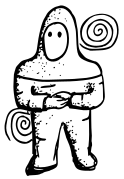
The Deck
A Nōm poker deck has 61 cards.
There are four suits, one for each type of Nōm: Clouds (pnōms), Tubers (gnōms), Worms (knōms), Eyes (mnōms).1
Each suit has the following cards:
| Number | Name | Visual Motif | Favored suit |
|---|---|---|---|
| 1 | The Ace | Abstract spirals blended with suit | None |
| 2 | The Oaf | Nōm about to blunder into danger (clouds: off a precipice, roots: into the jaws of a smilodon, worms: into a lake, eyes: into a carnival or house of pleasure) | Clouds |
| 3 | The Pauper | Nōm proffering a beggar's bowl | Worms |
| 4 | The Slave | Nōm laboring at a menial task (clouds: transcribing, worms: mining, tubers: tilling, eyes: various crude and vulgar exertions) | Tubers |
| 5 | The Martyr | Dead Nōm (clouds: pierced by wyvern sting, worms: lying in a grave, tubers: attended by mourners, eyes: skull among domestic paraphernalia) | Eyes |
| 6 | The Horizon | Landscape (clouds: mountains, worms: desert or plains, tubers: woods, eyes: island or sometimes a distant city) | Clouds |
| 7 | The Beguiler | Nōm absconding with something (clouds: scrolls, roots: loaves, worms: coins, eyes: another Nōm) | Worms |
| 8 | The Tree | Nōm reclining in part of a tree: (clouds: upper branches, worms: roots, tubers: cleft, eyes: trunk) | Tubers |
| 9 | Masks | Nōmish masks arranged in a 3x3 grid. | Eyes |
| 10 | The Orator | Nōm in a significant hat lecturing to a room of students | Clouds |
| 11 | The Claviger | Nōm holding a ring of keys2 | Worms |
| 12 | The Matriarch | Nōm queen in cermonial dress | Tubers |
| 13 | The Prophet | Nōm depicted as an obscure figure within a larger scene (clouds: cumular academy or mountain peak, worms: grand bazaar, tubers: forest, eyes: night sky, or intricate spiral) | Eyes |
Additionally, there are three more cards that lack suits: The Irð, The Sea, and The Welkin.
Sequence of Play
Prior to each round, the deck is shuffled. The dealer turns over the top card and places it in the center of the table. This card is known as the "collector" or "tax Nōm", and it is customary to pile bets atop it. All players pay an initial ante (typically one silver or gold coin or one tooth).
Seven cards are dealt to each player (for large games, this may be reduced to six or five). As in a typical poker game, players take turns either upping the ante or folding. When betting ends, players that haven't folded reveal their hands and then determine score (see combinations below).
Subsequent rounds
The winner of the first round is dubbed the "Lord" or "Potentate", and the lowest scorer is dubbed the "Bondsman" or "Canton Serf". During subsequent rounds, the Lord has the privilege of acting as dealer and may choose to take a card from the Bondsman's hand (without looking). However, table etiquette (commonly known as "the noblesse oblige rule") requires that the current Lord pay to refresh any drinks that are finished during his/her/their tenure.
Combinations
| Name | Hand | Score |
|---|---|---|
| Three-of-a-kind | Card's value | |
| Four-of-a-kind | Card's value +1 | |
| The Omphalos | Ace, Horizon, Prophet | 7 |
| The Pilgrimage | Tree, Horizon, Prophet, (Irð, Sea, or Welkin) | 5 (9) |
| Lucky Nōm | Oaf, Pauper, Beguiler, Claviger | 10 |
| Luckier Nōm | Oaf, Pauper, Beguiler, Matriarch | 13 |
| Luckiest Nōm | Oaf, Pauper, Beguiler, Prophet | 15 |
| Unlucky Nōm | Oaf, Pauper, Martyr | -2 |
| Favored flush | Three cards share a favored suit | Highest card value |
| Goon squad | The other three cards of the same denomination as the collector | 13 |
| Optimates | Claviger, Matriarch, Prophet | 12 |
| Faces | Three (four) masks | 11 (13) |
| The Enigma | Ace, Martyr, Prophet | 22 |
| The Academy | Two Prophets & two Orators, or one Prophet and three Orators | 15 |
| The Market | Pauper, Beguiler, Orator | 9 |
| The Grave | Martyr, Tree, Claviger | 8 |
| The Welkin | Welkin and any three Clouds | 7 |
| The Irð | Irð and any three Tubers | 7 |
| The Sea | Sea and any three Worms | 7 |
| Bondsman's Boon | Three (four) Slaves while Bondsman | 12 (18) |
| Lord's Lament | Three (four) Matriarchs while Lord | -1 (-5) |
| Forest | Four Trees | 11 |
| Aces | Four Aces | 17 |
| Contending Doctrines | Four Orators | -3 |
- To score, cards must be physically laid out, crossword style. Thus, a card can contribute to at most two combinations. Combinations that incur negative points must be laid out first.
- Combinations where all cards belong to the same suit as the collector are worth twice as much.
- In case of ties, the player with the most cards in the favored suit wins. If still tied, the player with the highest card of the collector's suit wins. If still tied (i.e. nobody has a card from the favored suit or their is no favored suit), the player with the highest-value single card wins. If still tied, the player with the most suitless cards (Irð, Sea, or Welkin) wins. If still tied, the players with the highest total calculated by adding the number values of the cards in their hand wins.
- If the collector is...
- ...The Irð, combinations involving The Tree are doubled in value, but any hand that contains The Martyr loses 10 points.
- ...The Sea, each "character" card (Oaf, Pauper, Slave, Martyr, Beguiler, Orator, Claviger, Matriarch, but not Prophet) reduces a hand's score by 2 points.
- ...an Ace, all numerical card values are reversed (i.e. value subtracted from 14)
- ...a Prophet, all combinations are scored, rather than just those that can be laid out in a grid pattern.
- ...The Welkin, a second collector is drawn, placed face-down, and then revealed when scoring begins.