Chainmail Combat for OD&D: A Reflection
In my ongoing Murdicog's Manse Antarctic Hexcrawl campaign, I decided to try resolving combat using a derivative of the Chainmail "Man-to-man" combat matrix, which supplies a target number for each possible paring of weapon vs. armor. I've seen "OD&D + Chainmail" come up as a topic of discussion fairly often, but haven't seen as many reports of how it goes down in practice, so I thought it worth writing up my sliver of experience.
You can read my house rules here, including the Chainmail-inspired tables.
I compiled my version of the table by hand, using both the original Chainmail numbers and those drawn up by blark for Meatheads as a reference.
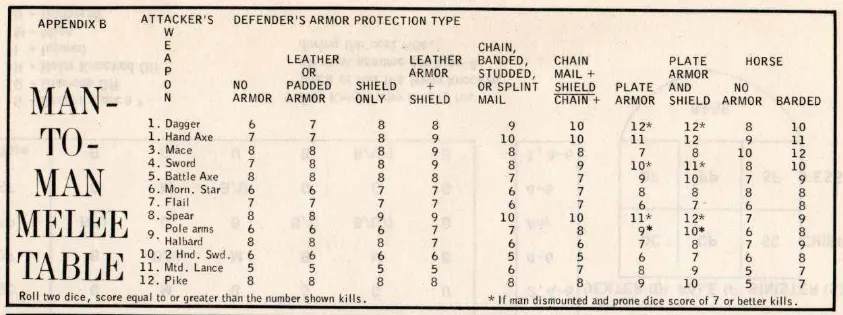
Gygax & Perren originally designed this matrix to simulate fights between two regular dudes; the Fantasy Combat matrix was intended to resolve clashes between heroic types and monsters (and the "alternative" combat system in M&M may have been intended to replace it). To make M2M work for human vs. monster, I adopted the Meatheads approach of using the "Horse" and "Barded Horse" columns for "Large" and "Large and Armored" monsters respectively. And for higher-level characters, I ruled that fighters get a +1 bonus every three levels (i.e. at 1, 4, & 7).
I should also note that I just used side-based initiative rather than basing it on "weapon class". This simplified combat but also chopped out one of the strategic layers from weapon choice.
The first tests were a bit rough -- there were a lot of misses, and I hadn't introduced the damage matrix so all hits were doing 1d6. Combat really dragged. To address this, I let fighters pick a "favored weapon" for a +1 to-hit, tweaked a few target numbers down, and introduced a damage matrix based on that in Meatheads (which I think was originally inspired by Troika!).
Subsequent fights felt better. The damage matrix helped the most, I think, by nudging average damage up from 3.5/hit. When a hit was scored, it usually packed a punch.
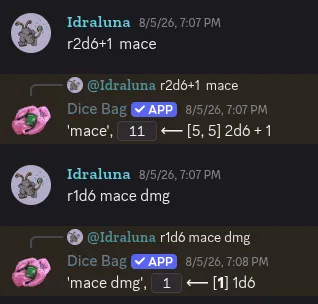
Getting the hang of actually using the system took some practice. Since I was running the game on Discord in the Gay Beholder server, we used the rollem bot. Having players append what type of weapon they are attacking with to the die roll was essential for mapping rolls onto the right line of the matrix. I would also publicly state enemy armor so that players knew which column to consult.
Anyway, here's a summary of what I see as the pros & cons:
Pros:
- The matrices can be expanded as needed to accommodate unusual weapons. This is wonderful for an expansive setting like Antarctica -- I have rows for Martian radium guns, Grey Alien lasers, Mi-go electro-guns, muskets, etc.
- The Meatheads/Troika! damage matrix means that hits do slightly more damage on average, and it makes max damage rolls very exciting. This compensates for the slightly higher whiff rate associated with the to-hit matrix. In general, I much prefer combat that is uncertain and "swingy" over the methodical attrition of something like 5e or Pathfinder.
- The OD&D range of +1 to +3 bonuses feels much better on 2d6. The impact of something like Bless is much more noticeable, and +3 swords feel properly heroic.
- Using a "wargame-y" matrix has an ineffable aesthetic appeal.
- Having granular weapon vs. armor contingencies mapped out opens up a whole space of possible player decisions. Likewise, there are extra "knobs" to fiddle with for magic weapons and such.
Cons:
- It's a lot of table lookups. Not something I mind (I'd rather that than mental arithmetic) but it can be fiddly.
- Because each weapon has its own target number, you can't scan a bunch of player rolls at once and assign who hits. It is essential that players append their weapon to each roll in the Discord chat to make it easier to track hits.
- The matrices have rows for "Large" and "Large & Armored" monsters (originally "Horse" and "Barded Horse") -- a judgement call is required to decide whether a given monster qualifies as "Large". Obviously a Chimera is large, but what about a Manticore? A Giant Lizard? A Giant Scorpion?
- I cannot recall an instance where my players actually selected a weapon for its properties -- even though the matrix in theory makes some weapons optimal for certain situations, nobody was interested in getting that fiddly.
In conclusion, I wouldn't recommend Chainmail M2M for all tables, but I like it enough to not regret trying it out for this campaign. The parts I'm most attached to are the use of 2d6 for to-hit rolls (I really think a +5% bonus for even a weak magic sword is just too wimpy), the ability to define guns and lasers without fiddly special rules, and the juxtaposition of lowered hit rate with increased damage rate. If those resonate, it might be worth giving it a try, otherwise you're probably better off with something like Target 20.
Bonus Post: Draft Combat Rules
I think that in future Antarctic campaigns (if I run in-person or if the Gay Beholder open table winds down and gets "rebooted" at some point) I would like to try a simpler combat ruleset that nods to Chainmail while incorporating the maneuvers in this very cool post by Dungeon Doll.
The following is an early draft. It needs testing and clarification and might well be a disaster, but I'd like to at least test it.
| Maneuver | None/padded | Chain | Plate | Helmet | Shield | Large | L&A |
|---|---|---|---|---|---|---|---|
| Disarm | 7 | 8 | 8 | - | 10 | X | X |
| Topple | 7 | 8 | 10 | 8 | 8 | 11 | 12 |
| Stun | 6 | 7 | 9 | 11 | 7 | 11 | 13 |
| Parry | 7 | 8 | 8 | - | - | 12 | 12 |
| Slash/bite | 5 | 9 | 11 | 6 | 10 | 7 | 11 |
| Stab/sting | 6 | 7 | 9 | 7 | 9 | 6 | 9 |
| Bludgeon/unarmed | 6 | 7 | 9 | 7 | 9 | 9 | 10 |
| Arrow | 6 | 8 | 10 | 7 | 9 | 9 | 11 |
| Gun/energy | 6 | 6 | 7 | - | 7 | 6 | 9 |
| Touch/giant | 8 | 7 | 7 | - | - | 7 | 9 |
See the original post for maneuver descriptions. This ruleset extends it by treating "normal" attacks (stab/slash/bludgeon) as one of a possible set of maneuvers, rather than treating maneuvers as a special case of offensive actions.
- The highest applicable AC value is always used. Thus, trying to stun someone in chain and a helmet requires an 11+.
- A dash on the matrix indicates that the equipment provides no benefit over just being unarmored. An X indicates that the maneuver is not possible under normal circumstances.
- Attacker gets +1 if higher HD than target, -1 if lower.
- Magic armor applies its bonus as a penalty to damage die rolls and to reduce defender HD for modifier calculation (above).
- Which attacks a weapon can make can be deduced via common sense. Swords can slash and stab. Spears can stab and bludgeon, halberds can do all three. Maces are bludgeon only, but morningstars can stab or bludgeon.1
- Boxcars (6 on both dice) always hit and deal max damage unless a helmet is worn, in which case they hit but do normal damage. Snake eyes always miss.
- Arrow & gun attacks take -1 per range band.
- Monsters:
- Mammals are usually treated as having padded armor.
- Reptiles are treated as having chain armor.
- Arthropods are treated as having plate and no shield.
- Large monsters: Ogres, Trolls, Rocs, Cave Bears
- Large & Armored: Dragons, Chimeras, Hydras, Large/Huge Robots
Damage rolls use the Meatheads/Troika! matrix, which means rolling 1d6 and then looking up the damage on a table. Wearing any kind of armor applies a -1 to the d6 roll (not the table result). Melee weapons held with two hands apply +1 to the roll. Magic weapon bonuses apply to the roll.
| Weapon | ≤1 | 2 | 3 | 4 | 5 | 6 | ≥7 |
|---|---|---|---|---|---|---|---|
| Unarmed | 1 | 2 | 2 | 3 | 4 | 4 | 6 |
| Dagger/athame | 1 | 2 | 3 | 4 | 4 | 6 | 8 |
| Hand axe | 1 | 3 | 3 | 5 | 5 | 7 | 9 |
| S. Robot stun prod | 2 | 2 | 3 | 3 | 4 | 6 | 9 |
| Mace | 2 | 2 | 3 | 5 | 6 | 7 | 8 |
| Shortsword | 1 | 2 | 3 | 4 | 5 | 7 | 8 |
| Longsword | 2 | 2 | 3 | 5 | 6 | 8 | 9 |
| Battle axe* | 2 | 3 | 3 | 5 | 7 | 8 | 10 |
| Morningstar* | 2 | 2 | 3 | 5 | 7 | 9 | 10 |
| Flail* | 1 | 2 | 3 | 4 | 5 | 8 | 9 |
| Bardiche* | 2 | 3 | 3 | 5 | 7 | 8 | 10 |
| Spear | 1 | 2 | 3 | 4 | 5 | 6 | 8 |
| Halberd* | 2 | 4 | 4 | 5 | 6 | 8 | 10 |
| Greatsword* | 3 | 3 | 4 | 6 | 7 | 9 | 11 |
| Mounted lance | 3 | 4 | 4 | 6 | 7 | 10 | 13 |
| Pike* | 2 | 4 | 4 | 5 | 6 | 8 | 10 |
| Shortbow | 2 | 2 | 3 | 3 | 5 | 6 | 8 |
| Longbow | 2 | 3 | 4 | 5 | 6 | 7 | 10 |
| Javelin | 3 | 3 | 4 | 5 | 5 | 8 | 11 |
| L. Crossbow | 1 | 2 | 3 | 4 | 4 | 6 | 8 |
| H. Crossbow | 3 | 3 | 4 | 4 | 5 | 8 | 10 |
| Pistol | 4 | 5 | 6 | 6 | 7 | 8 | 9 |
| Arquebus | 5 | 5 | 6 | 7 | 8 | 9 | 11 |
| Martian radium rifle | 2 | 6 | 7 | 8 | 9 | 10 | 15 |
| Martian radium pistol | 2 | 5 | 6 | 7 | 7 | 8 | 12 |
| Grey alien laser pistol | 2 | 4 | 6 | 7 | 8 | 9 | 9 |
| Grey alien laser rifle | 4 | 6 | 7 | 8 | 9 | 10 | 13 |
| Fungal alien electro-gun | 1 | 4 | 5 | 6 | 7 | 11 | 13 |
| L. Robot railgun | 2 | 3 | 9 | 11 | 12 | 13 | 15 |
Additional Notes
- The inclusion of the "giant" attack type entry is based on this post about an obscure early D&D spinoff (h/t Anne for mentioning it in the replies to Dungeon Doll's bluesky post). The idea is that sufficiently large attackers can basically ignore armor, at which point armor becomes a liability that impedes dodging.
- This approach accounts for redundancy between armor and shields, which I have wanted to address ever since reading this very good post. With this matrix, plate armor makes shields redundant except vs. disarm attempts. Conversely, unarmored + shield is pretty viable.
- Thus, those in plate armor are free to use more powerful two-handed melee weapons.
- I'm drawn to the idea of using this with a tighter level cap a la the various proposals for using Holmes Basic with its max level of 3 -- something with more down-to-earth human-scale characters.
I doubt it's necessary but I'd rule that sub-optimal attacks (like doing a pommel strike with a sword as a bludgeon attack) roll at a -1 or something.↩