AAJ 1.5 Guide
As I mentioned previously, at some point in the future I will run an official AAJ 2.0 on itch.
In the mean time, I've been doing a lot of editing, consolidating, and writing, and have learned some important lessons in the process. This post compiles the latest resources and guidelines for the AAJ and is directed toward folks who are writing entries during this interim period.
Changes from AAJ 1.0
The old rules still hold:
- No nazis, transphobes, or other bigots
- No generative AI
- Submissions must be licensed under CC0 or CC-BY-SA. Anything submitted to the jam comes with implicit permission to include it (with credit) in the Antarctic Adventure Anthology and for other participants to incorporate elements of it into their own work.
Moving forward, I ask that new entries adhere to the following:
New entries must be written for a generic OSR system with HD, descending AC, variable monster attack damage, STR/INT/WIS/CON/DEX/CHA, and the concept of 'saving throws'. This simplifies the webmap and Anthology layout, and makes it less burdensome for referees to adapt when players move between regions.
If you want to write for Cairn, OSRIC, WWN, DCC, Traveller, Troika! or other system for personal use and distribution, feel free, but the version of your entry what will appear in the Anthology will be converted to this OSR standard.
New entries are expected to incorporate material from the existing corpus of Antarctica Jam entries. Use monsters from the collaborative bestiary, reference other hexes, etc. You can always add something new, but try not to re-invent the wheel if something suitable is already in play. This is important for keeping page and word count manageable. With that said, you don't need to study everything -- the goal is connectedness not coherency.
New entries must follow the style guide. AAJ relies on scripts to update the webmap and generate a PDF of the compiled Anthology. If entries are formatted wrong, it looks sloppy and screws up some of the automation.
Additionally, the map is divided into subregions with pre-made templates. Instead of the messy process of drawing on screenshots, just tell me which region you want. Borders are negotiable. Each region comes with a template markdown file with some pre-rolled prompts to get things started.
Some subregions are already grouped into Regions which correspond to chapters in the Antarctic Adventure Anthology. If you key a subregion on The Spine (the snaky island in the top left), it will appear next to the other subregions on the island.
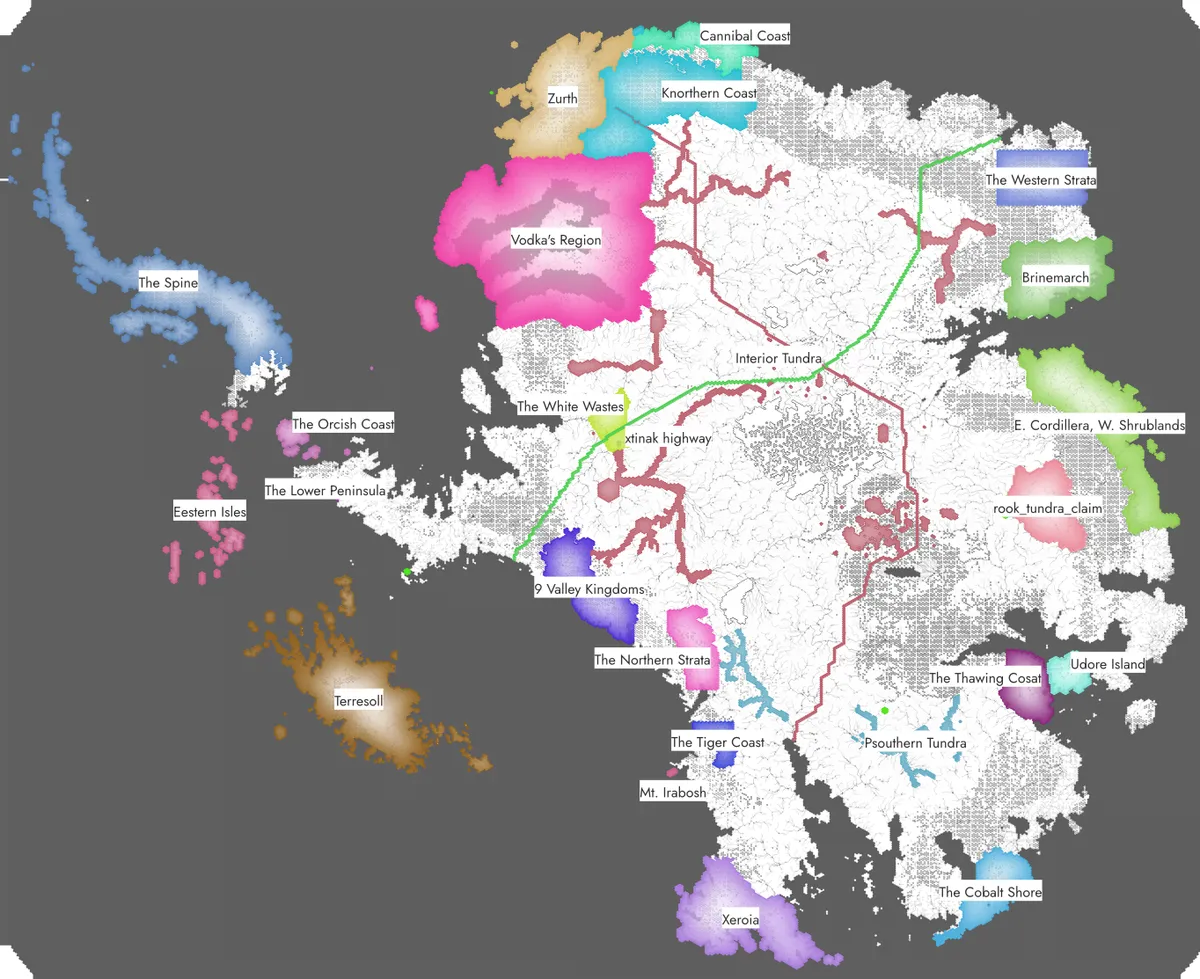 (It's a bit messy right now but you get the idea)
All of these new rules are flexible, particularly if you have an in-progress entry from before this was posted.
Future plans
The ultimate goal is to key at least 10,000 hexes (out of 110,000 total). Ideally, these hexes will be distributed such that no part of the map is completely unkeyed, though some may be very sparse. At that point, the project will be considered complete.
- AAJ 1.0: Feb. 2025-Feb. 2026 -- ~2,200 keyed hexes
- AAJ 1.5: ongoing, as described here -- currently ~3,000 keyed hexes
- AAJ 2.0 will basically follow the same rules as 1.5, but with the itch page and deadline of AAJ 1.0. Instead of a year, however, I'm planning for it to last 3, 4 or 6 months.
- The Final Sprint: I will generate template files of all remaining unkeyed regions. Participants will write three-sentence entries until we have 10,000 keyed hexes for an average density of roughly 1-in-10.
The end products will be:
- The Antarctic webmap. It's already fully usable, but I'd like to keep expanding its functionality.
- The Antarctic Adventure Anthology, a pdf and print-on-demand book (or books) compiling all the AAJ hexes.
- (Probably) The Antarctic Atlas, a companion to the Anthology with maps of each subregion.1
- A zine project to be announced soonish
All products from the AAJ will be free. I will host the pdfs on an AAJ itch.io and RPGTrader account, and will make print-on-demand copies available at-cost through Lulu.
I'm open to the possibility of crowdfunding nicer printed books and/or high quality poster-sized maps at some point in the future, but it's not an immediate priority.
Guide for New Participants
Selecting Your Subregion
The Antarctic hexmap has been preemptively divided into into subregions.
One subregion corresponds to one sub-chapter of the Antarctic Adventure Anthology. Most are between 30 and 300 hexes -- anything bigger and the map won't print properly on an a4 page.
To browse available subregions, visit the AAJ webmap. When you first arrive, both the Subregions and Claim Outlines layers will be toggled on. You can change what layers are visible in the Settings section of the panel in the top-right. If a subregion has been claimed, it will be indicated in the Claim Outlines layer. Any subregion that doesn't overlap with a Claim Outline is fair game.
Once you have selected a subregion to key, you need to do two things:
- Go to the AAJ Discord server and tell me what region you have picked in the
#region-claimschannel. Make sure you clearly communicate what name/pseudonym/handle you want to use, otherwise I will default to your Discord username. If you have a name in mind for the region, let me know that as well. - Request the markdown template corresponding to your subregion.
Keying Your Subregion
Using Markdown
AAJ uses markdown because it makes it possible to automatically sync new hexes to the webmap and the pdf Antarctic Adventure Anthology. Markdown is very easy to learn and is designed to be a user-friendly way of formatting plain text documents.
My top suggestion is to use Obsidian as a markdown editor. Obsidian makes it very easy to create lists, tables, and other advanced markdown features. Another good option is HackMD, which is browser-based.
You can also use Google Docs. If you simply copy-paste your template into a blank Google Doc it will format it correctly. When you finish filling it out, you can export back to a .md file.
If you use Google Docs, make sure to use its formatting features. Headings should be flagged as such, rather than just as bold text. Also, you must submit images separately; they won't export properly to markdown.
Style Guide
See here for the full style guide. It's ok if you don't follow it perfectly, but for me to be able to manage a project of this scale I really need everyone to do their best to adhere to it. The more time I spend correcting Bob is from 45, 678 -- Grackletown. to Bob is from Hex 45-678., the less I can spend on substantive feedback, organization, cartography, and writing.
In particular:
- Hex references really need to be formatted correctly. Do not include the name of the target hex, as this will be added automatically by Typst.
- If you are using Google Docs, don't write markdown code in google docs and then export to markdown, just use the built-in heading format and the exporter will handle the rest. OR, write in markdown format and then copy as plain text into notepad or something to make sure it is correct.
If you have questions, don't hesitate to ask in the Discord server.
Make sure to give each hex a name, and to delete the hexfill prompt once you've written an actual entry.
Submitting Your Entry
When you have finished filling in your entry, go to the #submissions channel on discord and post the .md file. (If using Google Docs, there is an option to export as .md in the File -> Export menu).
If you are comfortable using git, you can also join the git repository and directly push updates.
Your entry doesn't have to be polished to a T to be considered finished -- there will be opportunities to edit and revise.
If you haven't finished and need to drop out of the jam
- Please let me know. There will be no hard feelings -- writing hexes is time-consuming, life happens, and it's reasonable to prioritize other things. If you tell me you're dropping out, I can make your hexes available to future participants and know not to bug you as deadlines approach.
- If you can submit anything you have finished, please do so. Having something on the map is always better than empty space. Another participant may choose to finish your WIP.
A note about your submission
Submitting material to the AAJ means that you are implicitly giving me (editor-in-chief) permission to edit your entry for clarity, conciseness, & compliance with the style guide. I place high importance on respecting each participant's creative vision and will gladly involve participants in the editing process if desired, but I will exercise editorial authority to create an anthology that isn't horribly confusing.
Since your entry must be licensed CC-BY-SA or CC0 to participate in the jam, you are free to distribute it separately with total creative control, including charging for it on itch (as long as you cite the work of any other participants you reference).
Suggestions for filling your subregion
Templates are pre-filled via Luke Gearing's Wolves Upon The Coast hexfill procedure, which has proven consistently useful to past participants. They have have prompts for 1-in-10 hexes on average.2 You can insert additional entries, but instead of filling every hex in one subregion, I'd rather people spread the same amount of work between three or four subregions. (See here for more reasons why this can be good.)
The template prompts are there to serve you -- if they aren't helping you write, ignore them. And if you set out to write a "Settlement" and realize that it's actually a "Lair", this is a good thing; the categories are just suggestions.
I highly recommend spending some time perusing the Antarctic Adventure Anthology Appendices wherein all the monsters, spells, fighting techniques, in-universe books, and factions developed by past jam participants are compiled. Incorporating these into your entry makes the map more interconnected. Consider drafting your subregion's encounter table from the bestiary, then using it to fill in any lair hexes.
Additionally, please familiarize yourself with the hexes in whatever regions are closest to yours. You don't have to become an expert, but it's best if your work nods to the work of those who came before.
Antarctica is ultimately an anti-canon setting; there is no single coherent corpus of "lore" to conform to. What I want is a lively, messy conversation between different fantasy microcosms rather than many "walled gardens" that rarely interconnect.
FAQ
Jam-related
- Can I tweak the borders of my subregion? Can I divide it into multiple smaller subregions?
- Yes, as long as it doesn't affect an already claimed subregion (unless you've coordinated with those affected).
- Can I claim multiple subregions at once?
- Yes, but I would ask that you submit subregions as soon as they are finished.
- Do I have to adhere to the template?
- Definitely not. You can ignore the suggested hexfills, change which hexes are keyed, add new hexes, delete entries, etc. Likewise, you can change the encounter table to 1d20 or 2d6 or whatever else. Just make sure you adhere to the Style Guide.
- Can I introduce new monsters to the bestiary?
- Yes, post their stats in
#monster-mashon discord and I'll update the database. However, as of last jam, we have over 300 monsters -- please be judicious about what you add.
- Yes, post their stats in
- If I key several adjacent subregions, can I define them as my own region?
- Usually, yes. There are some regions with obvious, contiguous geography (like The Spine) that I'd prefer not to chop up, but this is definitely an option for mainland regions.
Setting-related
- Is this version of Antarctica cold?
- The general consensus is: coastal areas are more or less temperate or Mediterranean. Further inland, things get colder, and the large interior is a mixture of steppe, tundra, and (greatly reduced) glacial icecaps. Outlying islands are generally warmer, but even the warmest areas aren't truly tropical -- for example, the tiles marked as "jungle" could be thought of as temperate rainforests a la Oregon, Washington, and parts of Japan. BUT you are free to devise reasons why the local climate in your area is different.
- How big are the hexes?
- 6 miles.
- Is there a genre or vibe to the settings so far?
- Weird, pulpy science-fantasy. We've got space aliens, dinosaurs, necromancers, ruined cities, Deleuze references, convoluted financialized dystopias, zeppelins, mole people, and more.
- Is this version of Antarctica on the south pole? Do I need to account for the fact that the sun doesn't set in summer and doesn't rise in winter?
- I encourage doing so, but don't stress too much about verisimilitude.
- How closely do I need to follow what other people have written?
- Not closely at all. Antarctica is an "anti-canon" setting where not everything has to make sense. All I ask is that you riff on what other people have made -- maybe a monster someone else wrote can have a lair in one of your hexes. Maybe one of your notable NPCs is an exile from a neighboring land. These sorts of loose, small-scale connections matter more than maintaining coherent "lore".
In practice, I find that it's better to have the key be a separate document from the map, otherwise there's too much page-flipping. Moreover, including maps in the Anthology bloats up the page count, makes the pdf slower, and can lead to wonky formatting. I may change approach in the future, but for now I think it will make more sense to have printed maps in a separate book that can be optimized as such.↩
Note that hexes marked as "farmland" appear in the template with prompts to include a settlement. You do not have to adhere to these, but I recommend doing so as it makes the end result more coherent. With that said, I can always manually change farmland hexes to other terrain types upon request.↩