Zero-G Cage Match Rules for Classic Traveller
The spaceport bar on the industrial world of El Zocalo adjoins a zero-gravity arena that hosts regular fights. The players in my Odradek's Drift Traveller game have decided to sponsor a zero-g cage fighter, so I needed rules to resolve the match.1 I did a tiny bit of testing but probably not enough... there will be a proper review in a future session report.
The Arena
The arena has the shape of a flattened sphere with a diameter of 24 meters (it is effectively 2d, because simulating 3d zero-g movement feels like more trouble than it's worth). Gravitors mounted in the floor below create a local area of microgravity in which the fighters must maneuver. There are dull spikes mounted around all sides, and handles between them.
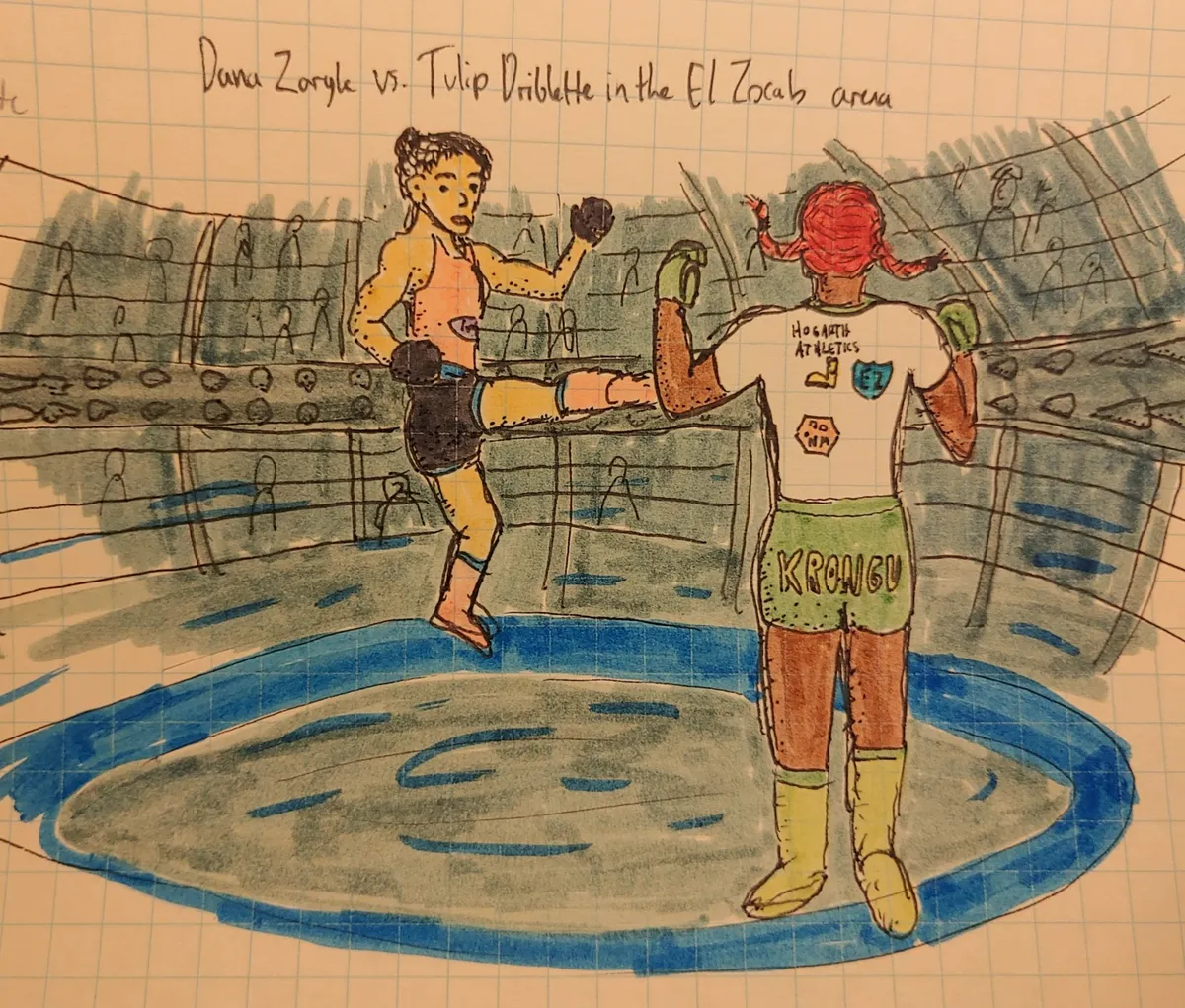
Typically, 2-8 fighters fight until the last fighter standing. Participants may tap out during any round, and are otherwise eliminated if knocked unconscious or killed. There is a Medic on-hand with Medic-3.
Obviously, there's a hyped-up announcer, and musical riffs play between rounds -- usually of the genre ZPO.2
Procedure
Rounds begin and end with all participants grabbing a handhold around the edge of the arena.
At the sound of the bell, all fighters launch themselves into the arena. Players pick a vector, specifying speed and direction. Speed may be 2, 4, or 6 meters/timestep, but those with STR of 9+ may choose a speed of 8, and those with STR of B+ may launch themselves at 10m/timestep.
Trajectories are plotted as 2-meter-wide vector-rectangles with a length equal to the fighter's speed, oriented along their chosen direction. Each timestep, an additional rectangle is plotted along the fighter's trajectory. If two segments associated with the same time interval cross, a collision occurs.
During a collision, each may choose to attempt one of the following:
- Passing blow: roll a melee attack as normal, noting Combat Blows and END (CT '77 p. 31).
- Apply a DM of Speed/2.
- Grab and hold, attempting to maneuver an opponent into colliding with a wall spike. Resolved using the grappling matrix below, also counts against Combat Blows
- If one party attempts to grab & hold while the other attempts to strike a passing blow, the fighter striking a passing blow does so with a +2 DM but rolls on the grappling matrix at a -2 DM.
- If a grab-and-hold attempt is successful, the fighters' new vector is calculated as the sum of their old vectors divided by two.3 If this has a length of less than one, they are considered stationary and may attempt to strike a passing blow for every timestep, or may attempt to shove an opponent out of reach (target number determined by the Grappling Matrix, only pusher needs to roll).
Regardless of whether fighters have reached a wall, the bell rings after 6 timesteps, signaling the end of a round. Fighters still in midair after the bell are retrieved with robot arms and moved to the nearest wall segment.
The "Whiff Rule"
If a round passes with no collisions, during the following round it is considered sporting for fighters to launch themselves directly toward the middle of the arena at a speed of 4m for a big scrum.
Grappling Matrix
Both parties roll against a target determined by looking up the row associated with their DEX and the column associated with their opponent's DEX.
Fighter A (9 DEX) faces Fighter B (5 DEX). A rolls against a 6+, B rolls against a 10+.
| DEX | 2-4 | 5-6 | 7 | 8-9 | A-C | D+ |
|---|---|---|---|---|---|---|
| 2-4 | 8+ | 9+ | 10+ | 11+ | 12+ | 13+ |
| 5-6 | 7+ | 8+ | 9+ | 10+ | 11+ | 12+ |
| 7 | 6+ | 7+ | 8+ | 9+ | 10+ | 11+ |
| 8-9 | 5+ | 6+ | 7+ | 8+ | 9+ | 10+ |
| A-C | 4+ | 5+ | 6+ | 7+ | 8+ | 9+ |
| D+ | 3+ | 4+ | 5+ | 6+ | 7+ | 8+ |
Results:
- One success, one failure: the fighter who failed risks a wall collision. The fighter who did not is fine. No further rolls; the loser is "pinned" until hitting the wall.
- Two successes: neither fighter risks a wall collision, but may roll again next timestep.
- No successes: both fighters risk a wall collision. No further rolls, both are "spinning out" until they hit the wall.
Wall Collisions
The arena walls are lined with dull spikes. For a fighter skilled at maneuvering in zero g, they are normally easy to avoid but can inflict serious damage in an uncontrolled collision.
To resolve a collision, roll 1D with a DM equal to speed/2.
| 1D | Result |
|---|---|
| 1-3 | Lucky landing, no damage |
| 4-5 | Glancing blow, 1D damage. |
| 6+ | Hit a spike. Damage equal to 1D + Speed. |
Movement Example
(Prepared in TLDraw, since that's where I'll be using this.)
Fighters A, B, and C begin at the edges of the arena.
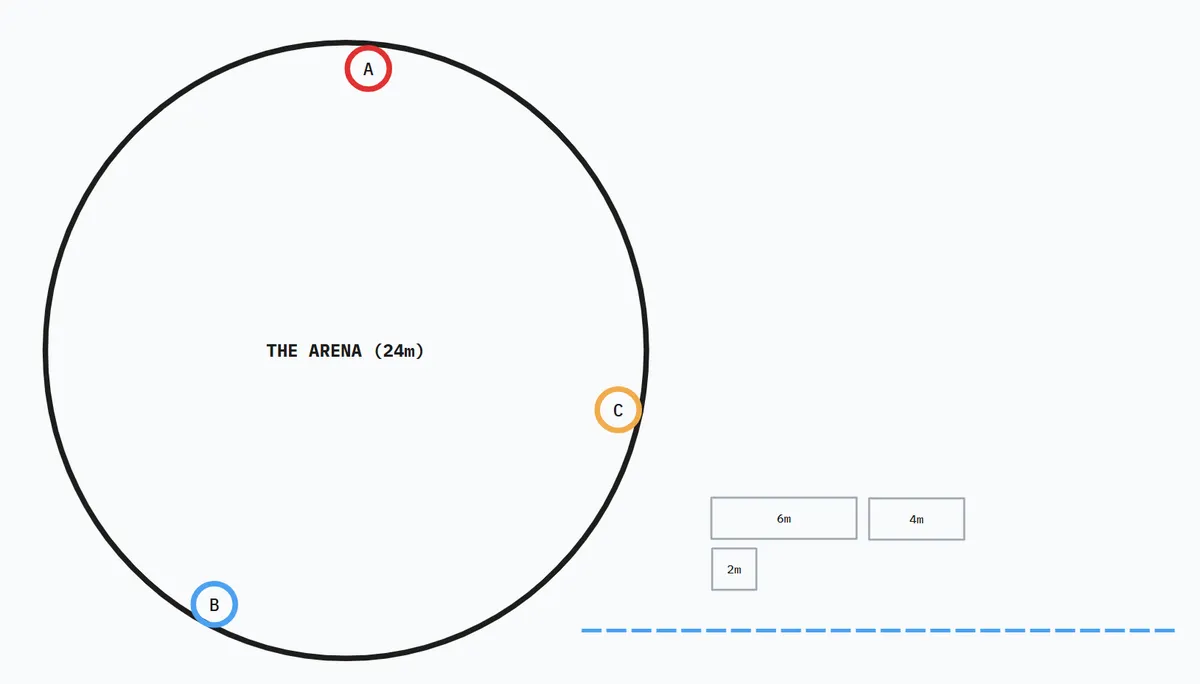
Fighter A chooses to move toward roughly 7:00 at a speed of 6m. Fighter B chooses to move toward A's start position at a speed of 4m. Fighter C chooses to move due west at a speed of 6m.
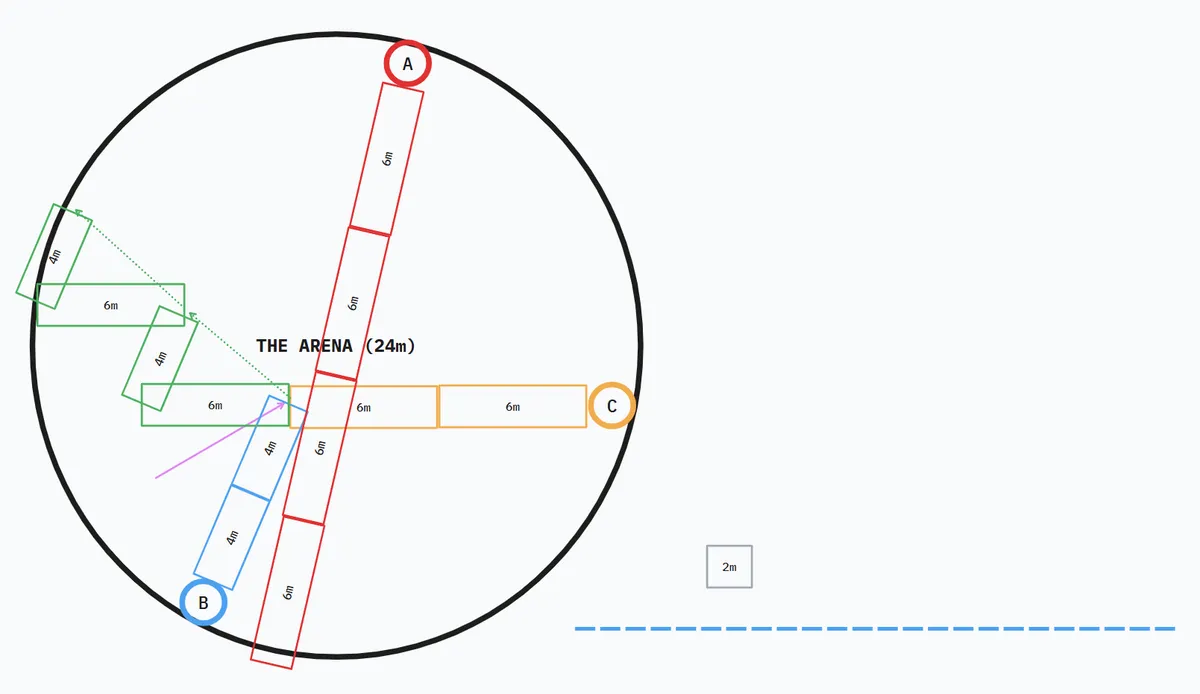
During the second timestep, the area traversed by fighters B and C overlaps, initiating a collision. In this case, they both choose to grab and hold. During subsequent timesteps, their vector is the sum of their previous vectors divided by two (dotted green line -- each summed vector represents two time-steps because I forgot how collisions work when preparing the visual).
A crosses the trajectory of fighter C during the third timestep, but by that time fighters B and C are elsewhere.
Thank you to MTB for sharing some helpful and inspiring notes.↩
"Zocaline Pulsation Onslaught", an electronic style that might be described as Drum and bass inflected with touches of experimental hyperpop.↩
As I understand it, if we assume the fighters are of the same weight (and El Zocalo is strict about weight classes), (v1 + v2)/2 is the correct outcome for a perfectly inelastic collision. I screwed this up in the example.↩