The Picket
Since May, I've been attending a weekly picket outside a local Chevron gas station.1 Chevron is a priority target for the Boycott Divest and Sanction movement because it is the main extractor of Israel's gas fields in the eastern Mediterranean and profits from an illegal pipeline running through the Gaza strip.
For two hours each Saturday afternoon, we (anywhere from 4 to 12 people) occupy a specific world, that of the street (specifically the "stroad"). In daily life, it is a world experienced in transit, ideally from the window of a private automobile. Standing in place for even two hours reveals it as a deeply inhospitable world: it's loud, hot, and smelly. The invisible boundary of private property has real significance (the cops get called whenever we transgress it). The traffic light cycle creates a hypnotic rhythm, lulls of quiet followed by a din of revving engines, supportive beeps, and the occasional shouted slur. Above all, it is exposed; to the sun, wind, and rain, and the eyes of thousands of passing drivers.2
But hospitable or not, it's a fully peopled world. We share the corner with panhandlers, pedestrians (often walking to and from the nearby grocery), transit riders, mormon missionaries, unhoused people, and occasionally other protestors (often looking for the ICE vehicles known to operate in the neighborhood). Sharing the stroad-world creates a bond; we pass out water bottles and snacks to people who seem thirsty or hungry, share tips with the anti-ICE protestors, chat with passers-by, let kids play with the chalk. Conviviality prevails even in the mutilated urban space of the gas station corner.
Within the Boycott Chevron crew, there is a sense of ritual, an unspoken amity as we zip-tie the same 30 signs and flags to the same spots on the same fence, week after week. It is the best example I have ever witnessed of acephalous organization -- we have no leader, no central organizer, minimal ideological unity (there's an outspoken Maoist, a member of the Democrat party, a few DSA people but most of us have no explicit affiliation). But every week we coalesce, hang up our signs and banners, disperse between the driveways and street corners, and quietly tip each other off about suspicious/hostile encounters. It's a foundational way of being-human that I haven't really experienced since I worked in a kitchen after college, but better insofar as the work is shared and chosen freely.
The pragmatic question: are we really doing anything? Lately, Chevron has started discounting their gas by $0.20/gal whenever we show up, which is about as objective an impact as you can ask for, however small.3 But it was when a car full of actual Palestinians pulled over to thank us that I knew I had to keep coming back. 4-12 of us meeting on Saturdays for two hours won't topple Israel or the Chevron corporation, but given the prevalence of hasbara and the uniquely intense suppression of the Palestinian struggle in the media, publicly, proudly supporting the struggle does matter, even if the effect is not tangible.
On a purely personal level, the most striking realization is that in 31 years of life, I had never before received hatred from strangers. I've been disliked, annoyed people, had personality clashes, etc., but until donning a kuffiyeh I had never experienced a certain kind of knee-jerk hatred, epitomized in my mind by the image of a sweaty, corpulent, mid-50s man with wraparound shades leaning out of his Chevy Silverado to bellow at the top of his lungs: "KILL ALL PALESTINIANS".4 I am a very shy person, poorly disposed toward confrontation, and have had to develop a thicker skin fairly quickly.5 There was a day in June when we were harassed by a young man, some kind of right-wing Ukrainian nationalist, I think, who got in our faces and lingered in a way that few others have. Even after he finally withdrew, he just sat in his car, staring at us. There was a deadness in his eyes that still creeps me out when I think about it. But he never came back and we did.
More on the haters: I've identified four loose types. The first is the hateful boomer mentioned above -- living perpetually in world under siege, brain liquefied by Fox News until it's fine puree of fear & anger. This group usually hurls slurs from within enormous trucks and SUVs but rarely engages beyond that. Then there's a type of smug frat bro6 -- instead of knee-jerk rage, they affect an attitude of bemused superiority ("Don't you have something better to do?"). I tend to ignore them entirely, but some comrades have gotten milage out of implying their patriotism has been co-opted by Israel. Occasionally, we run into centrist zionists -- arguably the worst because although they're too polite to yell slurs, they try to start conversations in bad faith -- "Why don't you protest the war in Sudan?" "Aren't all gas stations bad when you stop to think about it?". If the interaction is allowed to devolve, their ugly side does not take long to manifest. But many of the people we meet, though initially mildly hostile, are profoundly disillusioned and ready to engage in good faith -- they just need to be reassured that we're not terrorists, that we don't hate America, etc.
And it must be said that for every hater, there are dozens of passers-by who honk, smile and wave. Sometimes we keep score, and the supporters:haters ratio is usually ~250:5. People have brought us pizza, some regular commuters stop to chat and hang out. Since I started attending, our numbers have only grown. People know that what's happening in Gaza and the West Bank is a genocide. Increasingly, they know that the state of Israel is an apartheid settler-colony. Even people who struggle to manifest compassion for Palestinians have begun to resent Israel over AIPAC and the Iran War. For all the money and machinery arrayed against it, the tide is turning, however little and however late.
After the picket, when we're done packing away the signs and flags, we hang out in the grocery parking lot for an hour, just because we can. We share food and sip F's delicious milk tea. We chat about the news and our lives. Occasionally, A, a burly and gregarious Maoist, delivers an extemporaneous harangue on the evils of imperialism (it's more endearing than it might sound, in no small part because A is among the most assertive when things start to feel unsafe -- the harangues are earned). I don't know how long it will last, but for now, I'm very glad to be among them.
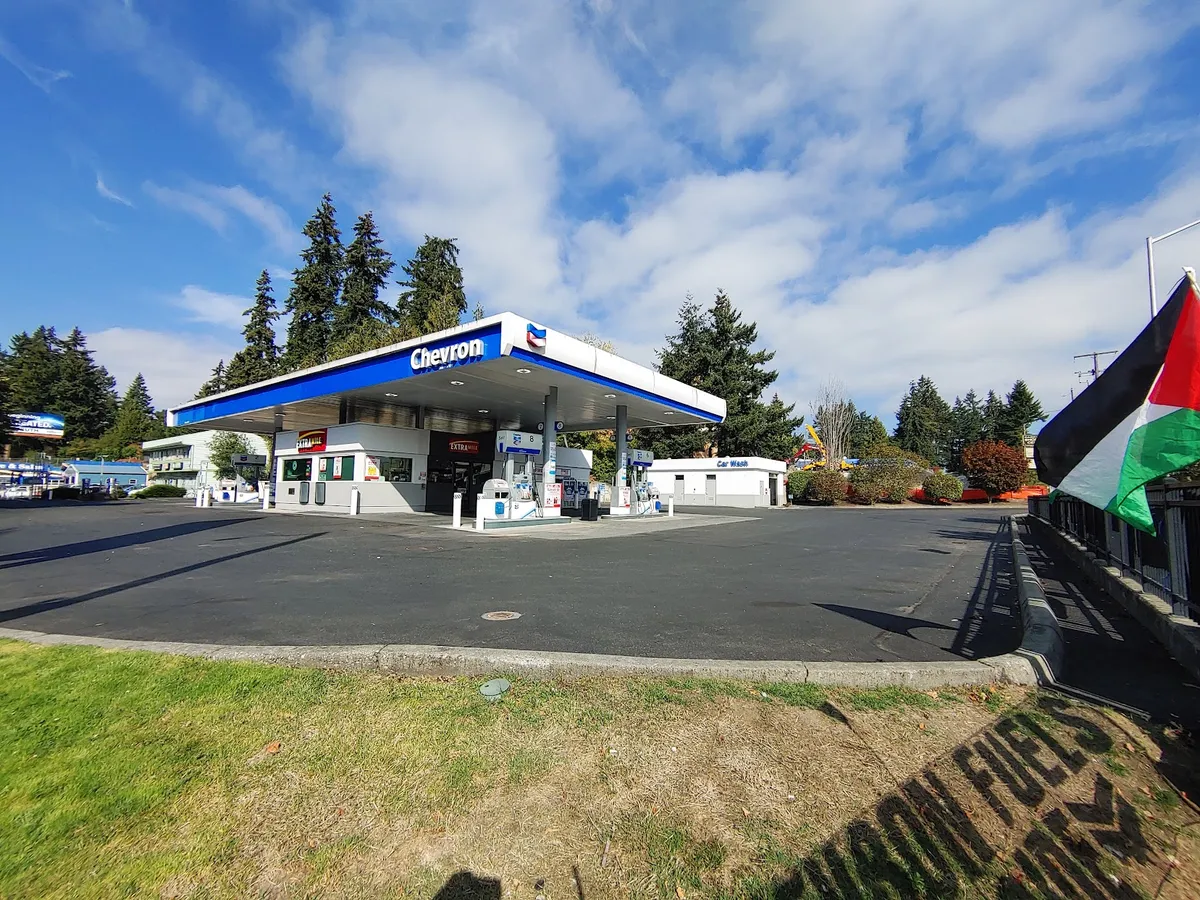
Against the noise and activity of the street, when there's a lull or an empty lot (our immediate goal, regularly realized) I sometimes I look up and see the flags waving against the peace of an endless blue sky and feel unaccountably that another world is still possible.
Free Palestine.
Taking a brief foray into diary-posting. I hesitated to post it for fear of coming across as performative, and it's not particularly instructive, insightful, or entertaining. But I kept composing it in my head because it's genuinely something I care about. So it's going as an off-topic post on the blog.↩
A healthy public space is one that allows people to modulate their level of exposure. The most pleasant cities I've visited always have somewhere to "duck into".↩
My hope is that this is actually fairly large relative to the amount of profit per gallon, but I don't know enough about the economics of gas prices to say for sure.↩
This really happened. Innumerable slight variations on this man exist everywhere.↩
Here I must be absolutely clear: being a white cishet man in a kuffiyeh for two hours on a Saturday afternoon is in no way commensurate with a the lived experience of the marginalized, nor are such personal, subjective experiences a prerequisite, supplement, or substitute for simply listening. But nonetheless, the experience is affecting.↩
This includes middle-aged guys that were obviously former frat bros. Golfer-types, often driving convertibles.↩