AAJ Interview Series 2: Hags
The second interview in the series is with Hags, who blogs at hags.bearblog.dev and has a substantial catalog on itch. She contributed The Nine Valley Kingdoms to Antarctica, a deliciously imaginative & rich set of hexes that take a "travelogue" angle inspired (among many other things) by books like Invisible Cities and the journeys of Marco Polo.
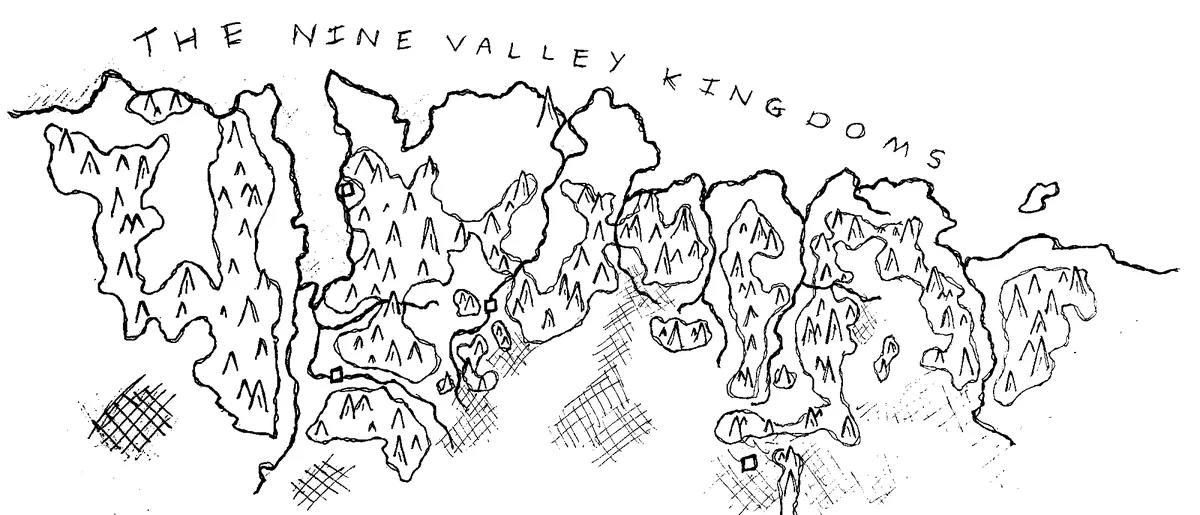 A map of the Nine Valley Kingdoms, by Hags
Idraluna: First question: What is your ttrpg background? How and when did you get started, and what games are you playing today?
Hags: I first played TTRPGs when in 2015 or so but they'd always occupied my imagination since I read about them in the Dangerous Book For Girls. 5e was my lens for understanding RPGs at that point. While at university in 2018 I encountered the LotFP adventures God That Crawls and Death Frost Doom, the latter especially becoming a staple of the games that I ran for beginners at my RPG Club (I later learnt of the module's unfortunate origin yet it remains a key touchstone in my development). From this point on I began developing my tastes from the crudeness of the "OSR" that was around then.
I started writing RPGs in earnest in 2023, putting out the Caverns of Keyhaven Keep for Emiel Boven's DURFJAM. It was kind of a manifesto about what I believed about RPGs at that point. Yet, in 2024, my dear comrade Taliesin Kincaid mentioned that she was on Luke Gearing's discord server. And then, the die was cast. I've become a committed believer in the Thinking Adventures school since then, and have played in a bunch of Wolves (and more lately Wolves-flavoured RuneQuest) as well as running a bunch of Violence.
At the same time, the sometimes spartan inclinations of the Big Red Dog gang have been tempered for me by the influence of my most deeply respected accomplice Alyssa, who has been developing what would probably be called a 'Heartbreaker' for nigh on five years: a fantasy system called Soldiers of Fortune inspired by the Black Company but with the mechanical chassis of Call of Cthulhu and Traveller-esque lifepath character generation. There are like a hundred 'perks' and half-a-dozen magic schools that are completely tied to the world she's developed: you can only take the stationary bow-user style (called Red Walls of Tuqetara) if you were born there or trained by a guard from there etc. It's the best stuff I've ever played. She is a wonderful GM yet basically considers herself to be just a "consequences generator" for all the political intrigue our band of mercs stumble into constantly. She's such a champ.
So basically what I'm saying is that I'm a Thinking Adventures disciple who's main RPG influence is a fairly complex tactics game that perhaps a dozen people have ever played.
**
Idraluna: Awesome -- I always like hearing about the ways people span different play cultures. Soldiers of Fortune sounds cool as hell.
Moving on to The Nine Valley Kingdoms, what tools (if any) did you use in the writing process? Are there any random tables or techniques that were particularly helpful?
Hags: This one's kind of a long one but you can't really complain when you're interviewing the people who have spent the last year writing tens of thousands of words...
My writing process runs along two parallel tracks. On one side, I write down a big list of cool things for individual hexes ('a succession of strong images'): stuff like "Giant Meadow", or "Salt Quarry", or "Giant Chinchilla". On the other side, I write down a list of rough thematic areas or sub-regions: stuff like "Kingdom of Dead Men", or "A Nameless Kingdom of Beasts" (secretly this was called 'Shadow of the Colossus Rip-Off' for a long time). These names often stick/
These two lists feed into and inspire each other. Eventually I merge them together and assign the big list of hexes into the smaller regions.
Beyond this point I continue to jot down more hexes (sometimes already assigned to regions, sometimes not), aiming to fill out the entire conceptual space for each region until I feel the idea has been fully explored.
In this way I'm kind of a fraud: I do recommend Luke Gearing's Wolves Hexfill Procedure a lot because I think it's a good general tool, but I personally just think of strong images with little consideration for ratios of different "hex types". Even more to that point, I don't think about exact hex locations within a region until well after I've completed that area (at most I think in the abstract about how certain entries might be near others and interact with them).
During Margrave, a module for Vyrmhack I wrote in 2025, I also developed a principle that guided me while writing the submission: "Gameable Concept In Every Hex". This was perhaps the single most important factor in how it came out. When I say "Gameable Concept" I don't necessarily mean 'monsters' or 'treasure' or 'town' or whatever (I literally have a new hex in my new submission called "Little Pigs" that's just populated by a sounder of piglets). I just mean 'something the players can talk about' or 'a thread they can pull on'.
I think this is important. There's a huge difference between a hex that says "5d6 Deer" and "5d6 long-eared deer that occasionally get their ears tangled in their horns; their ears are given to babies as teething-aids and are kept as good-luck charms" (this is 243-297 Igryxi Deer if you're curious).
I ultimately do this writing so that I don't need to improvise these kinds of details at the table. The prose under each hex is usually exactly what I would say when the players go there (I'm one of the people that write by speaking in their head and just copying it down) and it's just because I'm bad at verbalising loose images and concepts on the fly.
**
Idraluna: No complaints here! Regarding the two lists you mentioned, are they something you prepare ahead of time and then write fully hex descriptions after merging the lists, or is it a process you have ongoing in the background?
Hags: Of the ten-dozen-something hexes in The Valleys, I reckon that about eighty of them were set out and assigned regions prior to me 'breaking ground' with the writing. But inspiration often occurs when you begin writing (and just naturally over time). I have a collection of little A6 notebooks from MUJI that I constantly fill with images that I then transfer onto the merged list (sometimes at the top if I can't decide which region it belongs to yet, though it's often obvious).
**
Idraluna: The 9VK has the distinction of having the highest word count per keyed hex of any entry, but is on the lower end of keyed:unkeyed hexes. How did you decide to take this approach? (As opposed to lots of short hexes, for example)
Hags: Ooo! Those are fun stats! The high word-count probably comes from my own style of writing and preference for 'writing now to avoid having to do so on-the-spot later' (i guess some people would call this 'boxed text'). I did admittedly go quite wild, though I tried to restrain it to "deliberate lyricism" (one may notice my unfortunate obsession with alliteration and kennings) rather than being eedlessly verbose (as has happened in this interview). This is why you need an editor folks! Even if that editor is just you after a week...
The low keyed-unkeyed ratio comes from a conscious effort to contrast the very high ratio of other contributors. In my mind, the Valley Kingdoms are these memorable but sparse places that you travel through while going between more lively metropoles. I mean there's more cities in a thirty-mile stretch of Udore' Isle's Coast than the entirety of the Nine Valleys! It's also for the theme a little bit: Ibn Battuta and Marco Polo probably travelled for some time between each city-stop. Secretly, it's also just me being a bit economical. By having the region be composed of valleys separated by explicitly impassable mountains I could cover quite a big swathe while not having to write quite as much as if I did the same area in the desolate inner-tundra (though I do want to take a stab at that at some point). I also hope that this has helped encourage slightly more timid contributors by showing that it can be a bit less dramatically dense (and less of a commitment) than those other absolutely beautiful but quite intimidating regions.
**
Idraluna: I really appreciate that you did so -- I had hoped the jam would exhibit a variety of keying styles, and so I always like seeing participants mark out new territory within the density-verbosity possibility space.
Are there any lessons you took away from writing 9VK, or things that you're doing differently for The Cannibal Coast (or other future projects)?
Hags: Write shorter hexes! Though I have the sneaking suspicion that I've scuppered that goal: I've done about sixty hexes and ended up with about 13k words. Printer-ink salesmen salivate at my name... I've also tried to do more hexes that are a bit more straight-forwardly involved with the business of killing foes and accumulating wealth and treasure: I worry that the Nine Kingdoms didn't have much to satiate people running games that are strictly "gold-as-xp". Encountering the Little Pigs is all the nicer when they're contrasting the monsters you've killed and the magic-items you've found.
Also I've been keeping illustrations more in mind while drafting hex ideas instead of scrambling for pictures that fit after the fact. Wikimedia Commons is such a trove for inspiration. Some have said that a picture is equivalent to some or other number of words. This might be a strategy going forwards to reduce word count...
**
Idraluna: Just a couple more: First, I don't want to close out the interview without also mentioning nokatelo marsh, which uses the toki pona conlang for all of the hex names. Can you talk a little bit on how you landed on that and your writing process?
Hags: Oh wow of course! Thank you for acknowledging nokatelo. That region was the first thing I wrote for the AAJ and it came entirely from spending a year at university reading about the Inuit peoples under Prof Mike Bravo. He's a very intelligent and thoughtful guy who has spent a lot of time in the Arctic doing this really interesting brand of geography-anthropology-philosophy. In nokatelo I tried to communicate some of the really interesting traits commonly associated with the Inuit peoples' world-view, especially this notion of a "relational ontology": that things only exist as a node in a web of relationships between other things. There's been a ton written on Inuit trail-making, for example, and each place is thought of by individuals as existing in the chain of the trail (as before this, or after that) and as being encountered for a specific reason (they go here in this season for this reason), and are often described with symbolic stories. There's even a bit in one paper about how in interviews elders tend to describe specific locations as if they are currently travelling there... There's obviously a lot here that can be applied to the medium of a hex description. In that way nokatelo is kind of more a statement about the medium and it's western and imperialist biases. I wrote in these two ways: in 'relational' terms (never using absolute descriptions), and from a 'hypo-diegetic' perspective where each hex-entry is like an elder describing to the young the path of a given hunting-trail through the marsh. The last thing is that I used the toki pona conlang (which is a wonderful and beautiful little piece of art in itself) to avoid that old pitfall of "going on google translate and mish-mashing vaguely relevant foreign words together in an orientalist way". If you're interested in this at all I did write a longer blog post on the region where I link to a bunch of the papers I recall.
**
Idraluna: It's a really extraordinary contribution to the jam, I highly recommend readers of this interview check it out.
Final questions: Of the hexes you've written, which is your favorite? And aside from your blog and itch.io, are there any projects or links you'd like to plug?
Hags: You'd make me choose between my children? Hmm. Probably The Midden. This is one of those hexes inspired by a single strong image: a Mad Cossack pirouetting and gamboling about in a dark void... I think it's hilarious... It mostly came from my wife.
As for shout outs, look forward to The Cannibal Coast which I'm releasing in volumes on my bearblog. I've made it a goal to have at least a tenth of the hexes contain an age-gap lesbian couple, and another tenth contain mythological horses. I don't think there's overlap though... yet...
Big ups to the community. Big ups to Idra for making this all happen in the first place. Furthermore, transphobes delanda est.1
Ed. note: Co-signed, happy pride!↩